
By Deanne Jeffers
THE State Government’s controversial new Emergency Services and Volunteer Fund (ESVF) passed in parliament’s upper house last week. The move was widely opposed by key advocacy groups, including CFA members, farmers, and regional councils.
Starting July 1, 2025, the Fire Services Property Levy (FSPL) on council rate notices will be replaced by the ESVF, to fund a broader range of emergency services. Under the changes, every landholder in Victoria will pay more, but farmers are facing increases in the tens of thousands of dollars, hitting them hardest during a time of drought.
Greater Shepparton City Council Mayor, Councillor Shane Sali, said Council is extremely disappointed that the fund will lead to more money being directly taken from regional Victoria.
“For our municipality alone, this change means an increase of more than $4.7 million, compared to what is currently collected under the FSPL. Under the new structure, the primary production variable rate will rise sharply from 28.7 cents to 71.8 cents per $1,000 of Capital Improved Value (CIV), a shift that disproportionately affects regional and rural areas.”
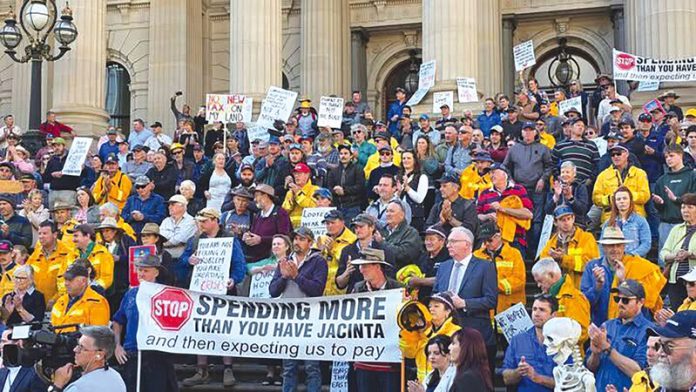
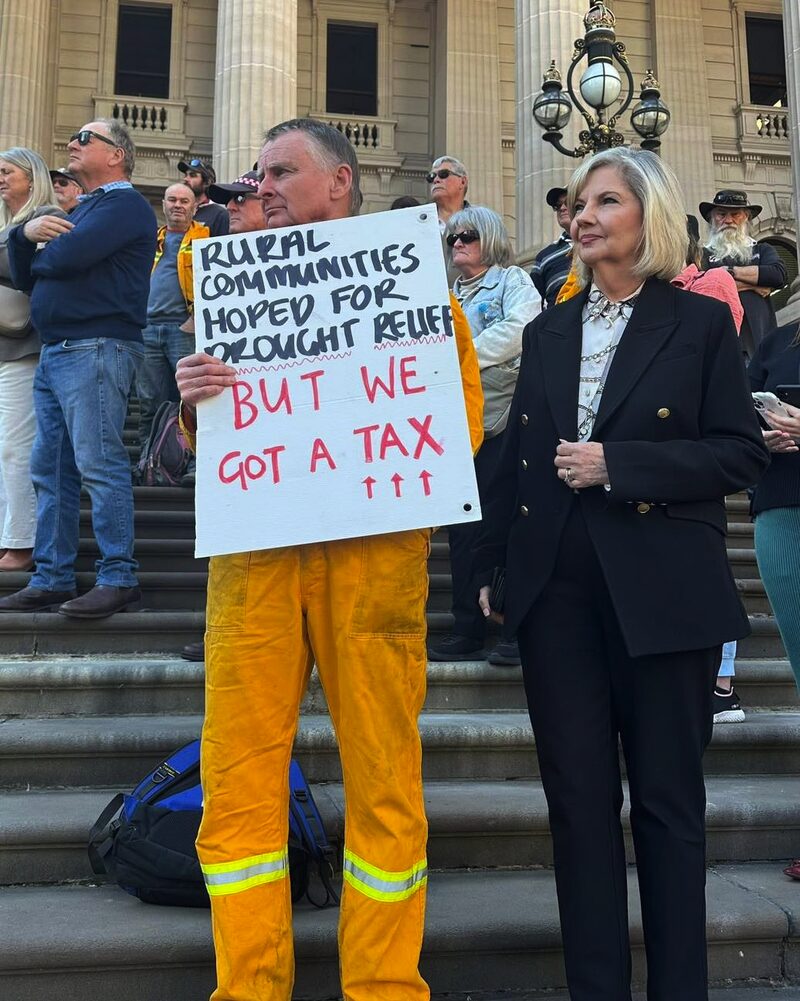
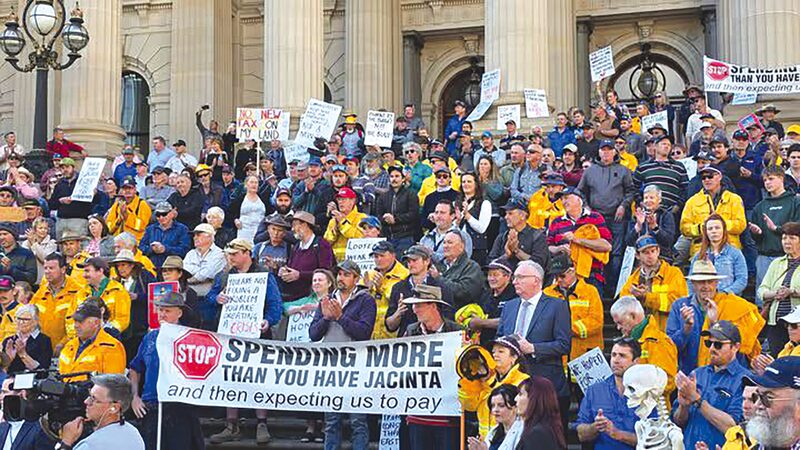
CFA firefighters and farmers downed tools last week to protest the ESVF on the steps of parliament. More protests were planned for Tuesday, as The Adviser was going to print, and Treasurer Jacinta Allan prepared to deliver her first State Budget.
Since the vote in parliament, around 200 CFA brigades are reportedly offline, and a petition has started calling for the introduction of the ESVF be ceased and for the government to commit to genuine consultation.
Mooroopna CFA, which has confirmed it is still responding to call outs, erected its CFA flag upside down, as an act of defiance and to signal the distress this legislation places on CFA members. The brigade has asked the community to sign the petition and write to Victoria’s Governor General to plead that the ESVF is not signed into law.
Before the heated parliamentary debate last Thursday, Treasurer Allan confirmed the government had struck a deal with crossbench MPs to support the legislation. She said amendments were made to address farmers’ concerns.
Amendments included dropping the levy rate for farmers from 83 cents for every $1,000 of a property’s CIV to 71.8 cents. The current rate is 28.7 cents.
She also said that CFA volunteers and farmers in 24 shires eligible for drought support would be exempt, although this is only short term and does not include the Goulburn Valley region.
Opposition members, including Liberal Member Wendy Lovell and One Nation Member Rikkie-Lee Tyrrell, voted against the levy, citing its impact on Victorians, particularly vulnerable farmers and renters, during a cost-of-living crisis.
“Labor, together with the Animal Justice, Greens, and Legalise Cannabis parties, have completely sold out Victorians, doing a dirty deal to ram this controversial bill through parliament in the early hours of Friday morning,” said Ms Lovell in a statement, highlighting that the ESVF is the 60th tax to be introduced by Labor since being elected in 2014.
“Large parts of rural Victoria are currently experiencing horrendous drought conditions, and farmers are under incredible financial stress. To impose an excessive new tax on them at this time, so that Labor can fill its budget black holes, is heartless and cruel.”
Member for Shepparton District Kim O’Keeffe said it was “appalling to sit in the chamber and listen to those supporting this bill trying to justify it.”
“Hardworking Victorians will be slugged $2.1 billion across the next three years under the new tax with Labor forcing Victorians to pay extra for core government emergency services currently funded out of consolidated revenue,” she said.
“The tax liability of farmers will jump by 150 per cent when compared with the old fire services levy, all to compensate for the financial mismanagement of the out-of-touch Allan Labor Government.”
Regional Cities Victoria (RCV) member councils are bracing for a $60M hit to communities this financial year alone from the new ESVF. Councils are also concerned about how they will implement this new levy, saying they are yet to receive advice on implementation.
Cr Sali, who is Chair of RCV, said “Councils have a rate cap – this government needs a tax cap.
“It’s concerning that ensuring someone answers the phone at Triple Zero relies on regional and rural communities being slugged this new levy,” Cr Sali said.
“This consistent cost-shifting from the state is ultimately borne by our ratepayers, and it has to stop.”
You can sign the petition here: www.parliament.vic.gov.au/get-involved/petitions/emergency-services-and-volunteers-fund/
You can learn more about the ESVF here: www.dtf.vic.gov.au/emergency-services-and-volunteers-fund