

By Deanne Jeffers
Facing Modernity: Degas to Picasso at the Shepparton Art Museum (SAM) takes us on a journey through a transformative period in art history, the moment when painters and sculptors stopped trying to copy what they saw in front of them and started trying to capture what they felt. Styles like Cubism and Abstraction, which you’ll see plenty of in this exhibition at SAM, show artists breaking the rules of ‘realistic’ art to present feelings and ideas in new and intriguing ways, especially as the world around them was being turned upside down by new technologies and the horrors of war.
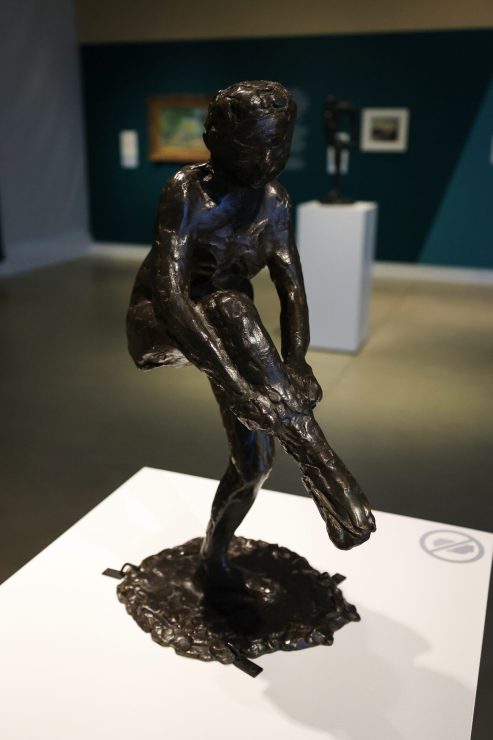
Danseuse mettant son bas [Dancer putting on her stocking] (1890s, reworked 1911), Edgar Degas
Unlike many portrayals of dancers where they look graceful and performative, this small bronze statue breaks the mould. Balanced on one leg, caught pulling on her stocking, you see there is nothing particularly stage-like about her pose. Her weight is off balance, her head dipping toward her leg, completely absorbed in what she is doing. It feels like an oddly private moment, more like glimpsing someone getting dressed than watching a performance. Where ballet paintings and statues typically showed dancers on stage, mid-leap, elegantly lit-up for the audience, Degas does the opposite, stripping all that away to show us a dancer when nobody is supposed to be looking. This reflects the shift away from idealised subjects, towards the real, the fleeting, everyday moments.
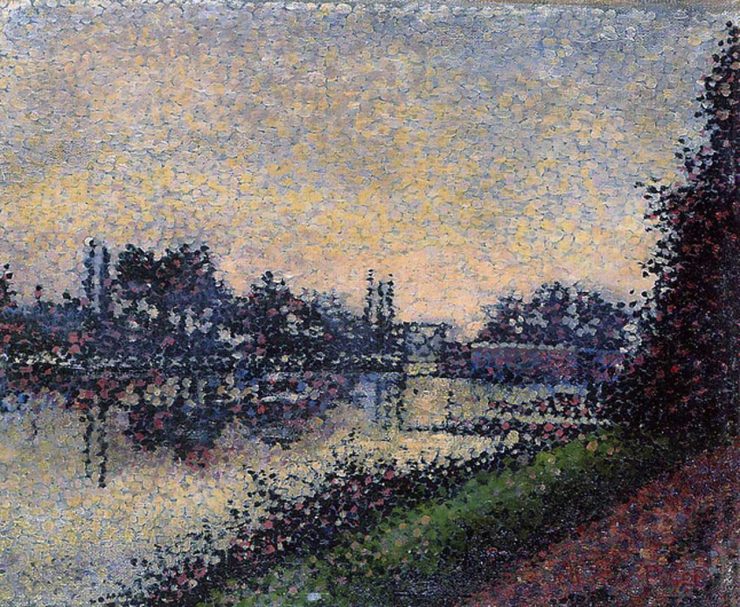
Paysage à l’Écluse [The Lock] (1886-87), Albert Dubois-Pillet
I am fascinated by this painting of a lock at daybreak, which is made up of thousands of tiny dots of colour using a technique called pointillism. Instead of blending the paint, the artist places small dots of pigment side by side and lets your eye do the blending, similar to how a TV screen builds a picture out of tiny, coloured pixels. This technique emerged in France during a period of significant social and political change and the artwork itself reflects the changing relationship between nature, industry and individual expression. One of the best things about this exhibition at SAM is that most artworks are displayed behind glass, meaning you can get very close to see how the small details come together. The scene itself feels calm and quiet, but there is also a quiet unease, showing how much humans were reshaping the natural world at the time.
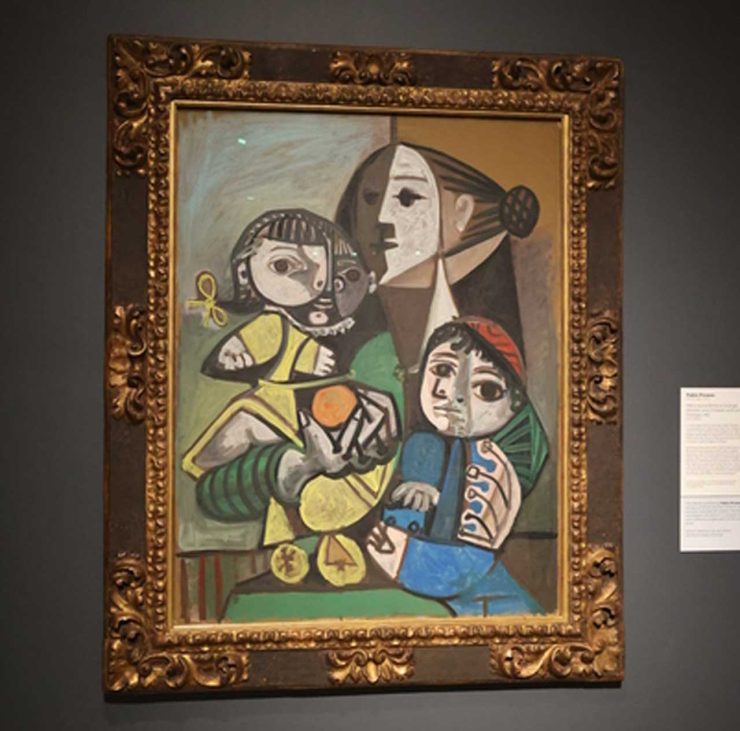
Mere aux enfants a l’orange [Mother and Children with an Orange] (1951), Pablo Picasso
At first glance, this is a classic subject depicting a mother holding her children, but Picasso turns it into something far stranger and more tense than your average family portrait. The woman is Françoise Gilot, Picasso’s partner at the time, and he paints her as two different people at once: one a ghostly, demure figure and the other a darker, angular, almost hostile face. She appears to be both staring past Picasso and focussed on the children, clutching their daughter Paloma on one arm and gripping son Claude with the other hand. Her fingers dig sharping into an orange she’s holding, a fruit often shown as a symbol of fertility and matrimony in artworks. It is not a cosy family portrait, but one with the tension left in. While many of the earlier works in the exhibition wrestle with light and form on nature’s terms, Picasso’s dismantled, fractured planes push modernity’s unease all the way to the domestic sphere, turning even motherhood into a site of psychological fracture.
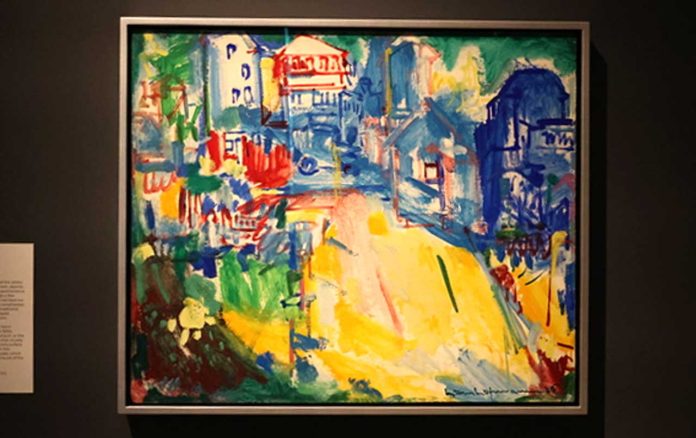
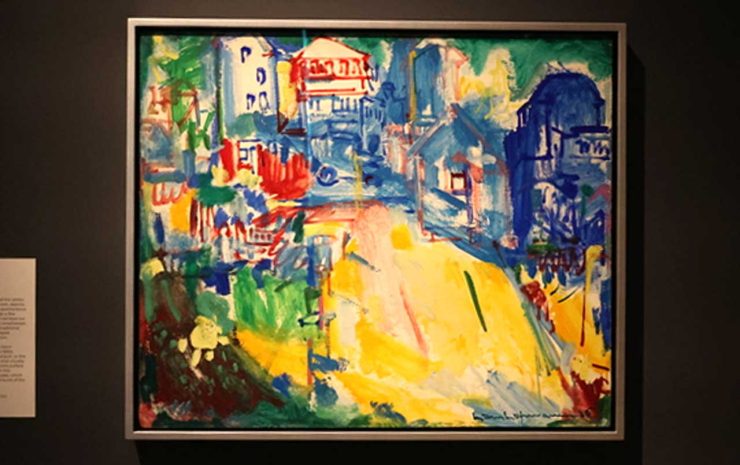
Landscape (1935), Hans Hofman
This painting doesn’t try to show you exactly what a landscape looks like, but rather I would say it instead tries to show you what it feels like to stand in one. Instead of painting trees, hills or buildings you could point to and name, Hofmann breaks the scene into vivid patches of colour, with warm tones and cool tones bumping into each other erratically. Some patches seem to jump forward while others seem to sink back, giving the painting the feeling that it is shifting the longer you look at it, almost like sunlight flickering through leaves or day turning to night. Up close, the brushwork is visibly energetic and spontaneous, with each patch of colour applied with its own gesture and pressure, giving the shapes that make up the landscape a distinct feeling that rewards close looking.
Facing Modernity: Degas to Picasso has entered its final weeks, closing soon on September 20. There is only a limited chance to experience these rarely-seen artworks from Auckland Art Gallery Toi o Tamaki, including masterpieces from Salvador Dalí, Henri Matisse, Paul Cezanne, Eileen Mayo, Georges Braque and more before they return to Aotearoa/New Zealand.
Facing Modernity is open daily from 10am-4pm, with extended hours to 6pm on Saturday, September 5; Friday, September 11; Saturday, September 12; Friday, September 18; and Saturday, September 19. To book tickets, go to SAM’s website: https://sheppartonartmuseum.com.au/whats-on/now-showing/facing-modernity-from-degas-to-picasso