
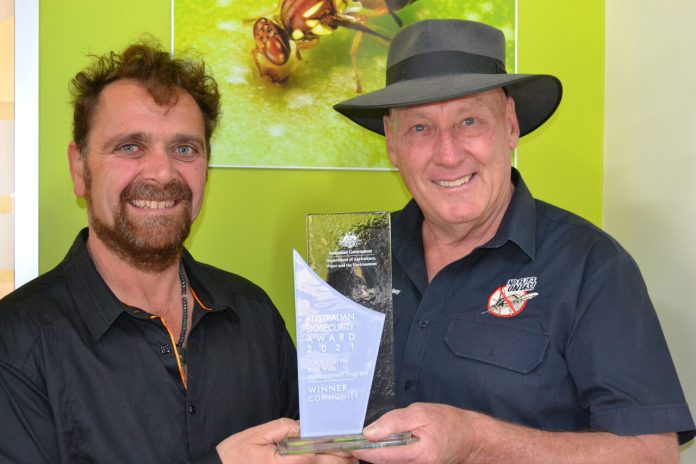
FRUIT Growers Victoria (FGV) and the Cobram and District Fruit Growers Association (CDFGA) are calling on the Victorian and Federal Governments to urgently act on independent evidence and commit to a properly funded, high input Queensland fruit fly Area Wide Management program for the Goulburn Murray Valley (GMV), including renewed consideration of the Sterile Insect Technique (SIT).
Following the recent release of a new independent analysis by internationally recognised fruit fly expert Andrew Jessup, which was commissioned by Greater Shepparton City Council, both industry groups say the evidence is now unequivocal. The GMV is one of Australia’s most fruit fly vulnerable regions, and meaningful suppression has only been achieved when governments supported control programs at the scale required.
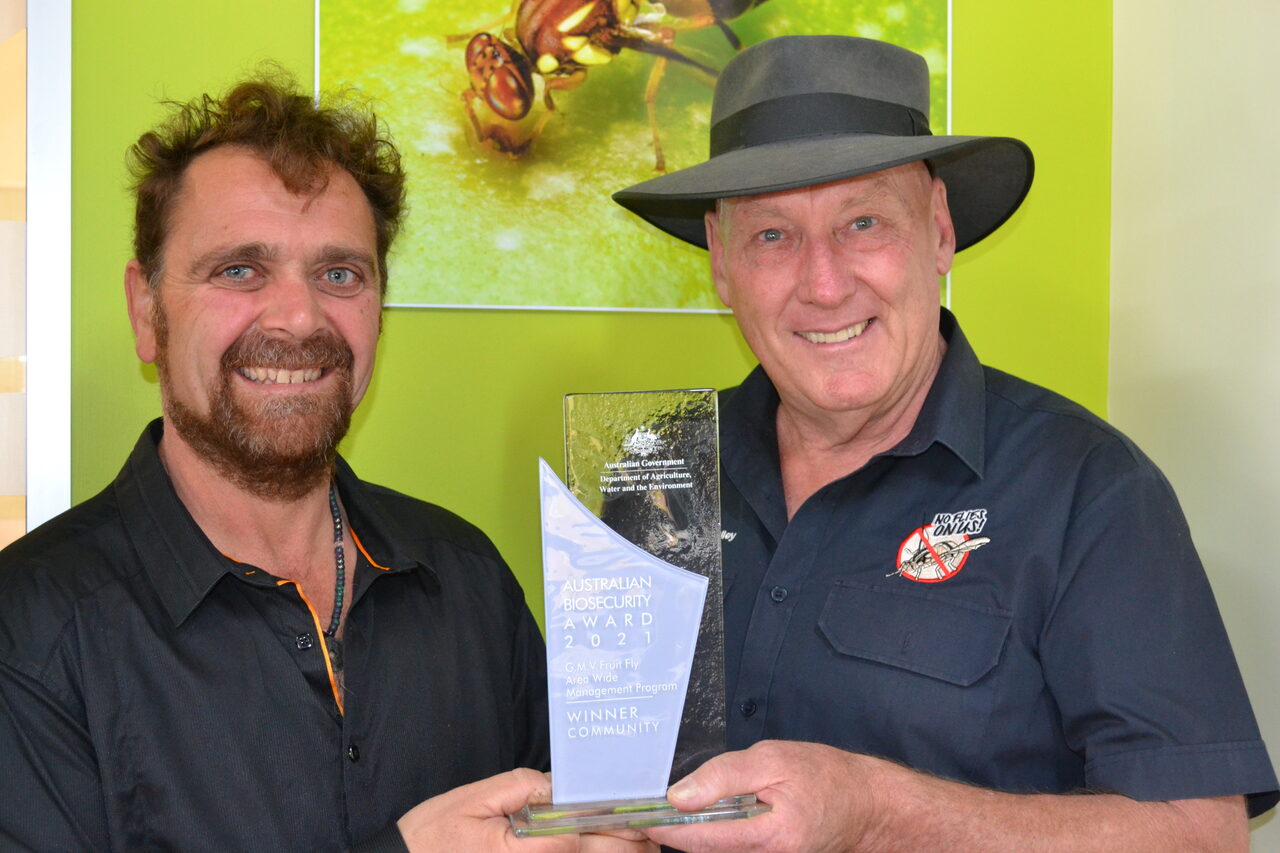
By instilling ownership in the community, industry and government, Queensland fruit fly populations were reduced by 60% across the GMV. An increased reduction of 83% was achieved in Cobram when sterile fruit flies (SIT) were released as part of three-year research trial. The SIT component of the program in Cobram was managed by Professor Phil Taylor, Head of Applied BioSciences and his team from Macquarie University, NSW Photo: Suplied
The analysis challenges long–standing Victorian Government assumptions that fruit fly management models from Queensland and New South Wales, neither of which are funded by their respective state governments, can be replicated in the GMV without the need for ongoing intervention in Victoria, effectively amounting to an attempt to absolve the Victorian Government of its responsibility for fruit fly management.
“This report removes any remaining uncertainty about what is required in a region like the GMV,” said Adrian Conti, President of the Cobram and District Fruit Growers Association.
“The science, the data and the lived experience of growers all point to the same conclusion. When the GMV fruit fly program was properly funded and operated as a true high input Area Wide Management program, it worked. When funding was reduced, pressure returned quickly and predictably.”
For many years, growers have pushed back against suggestions that the GMV can simply replicate fruit fly approaches used in parts of Queensland or northern New South Wales. The Jessup analysis confirms those comparisons are flawed and misleading.
The GMV is is vastly larger and more urbanised, grows a higher proportion of highly susceptible crops, experiences peak harvest during peak fruit fly activity, is exposed to significant through traffic and tourism pressure, and lacks the decades old natural predator equilibrium seen in northern regions
“This region requires tailored solutions matched to its risk profile. Applying the same assumptions used elsewhere increases the likelihood of repeated policy settings that fail to keep pace with the threat.”
High input Area Wide Management including SIT has proven its value. FGV and CDFGA say the most challenging aspect for growers is that effective tools are well known and already backed by evidence.
When the GMV fruit fly program operated as a high input Area Wide Management model, supported by full regional coordination, intensive field operations, strong community engagement, host tree removal, trapping and surveillance, and at one point during a trial in Cobram; targeted use of the Sterile Insect Technique, fruit fly populations were suppressed to far more manageable levels; achieving a 95% reduction in year 1 of the program, and a further 60% reduction in the second year. In the third year, SIT was then introduced in Cobram under a trial and QFF was reduced by a further 83 per cent.
“The Jessup report is clear that SIT plays an important role in reducing fruit fly pressure in large and complex production landscapes,” Mr Conti said.
“Growers have seen the benefits when SIT formed part of an integrated, well-resourced program. Its removal left a gap that other tools alone have been unable to fill.”
The analysis supports the re-introduction of SIT in high-risk regions such as the GMV, particularly when deployed in a targeted manner as part of a broader Area Wide Management system.
FGV and CDFGA say the Victorian and Federal Governments should now re-open discussions regarding SIT deployment in the GMV, noting that similar approaches are currently being implemented in South Australia to address elevated fruit fly risks.
“SIT is a proven, lower impact technology that suppresses pest populations at scale,” Mr McNab said.
“The fact that SIT is being used in South Australia reinforces the need for governments to revisit its role in the GMV. This is not a new concept. It is an evidence-based tool that deserves serious and renewed consideration.”
Without a properly resourced and government backed fruit fly management system, including consideration of SIT, growers warn the consequences will continue to escalate:
rising on farm control costs increased reliance on chemical controls reduced access to domestic and export markets unmanaged backyard infestations undermining commercial efforts long term damage to the GMV’s reputation as a reliable food producing region
“This is not only a grower issue. It is a regional and state economic issue,” Mr McNab said.
“The GMV underpins a significant share of Victoria’s horticultural output. Sustained under investment in fruit fly control places that contribution at risk.”
FGV and the Cobram and District Fruit Growers Association are jointly calling on the Victorian and Federal Governments to formally acknowledge the independent findings of the recent 2026 Jessup analysis, move away from simplified interstate comparisons, commit to stable and long-term funding certainty, reinstate a true high input Area Wide Management program rather than a scaled back coordination model, and to re engage in discussions on the role of SIT in the GMV in line with its use in other high-risk regions.
“We are asking governments to work with industry, look at the data, and apply the tools that evidence shows are required,” Mr Conti said.
“Every season of delay increases costs and compounds risk. These outcomes are avoidable with informed and decisive action.”
The report can be downloaded via: https://shepp.city/qffstrat
“This report makes it clear that fruit fly management is not a one–size–fits–all proposition,” Fruit Fly expert, Mr Andrew Jessup said.
“The GMV is fundamentally different to northern regions in terms of climate, crop profile, urbanisation, scale and the maturity of natural pest control systems. Applying the same model without adaptation significantly increases risk rather than reducing it.”