IN the wake of war, grief lingers—not only for the heroes who gave their lives, but also for those still waiting for answers about the fallen who were never found.
In the small town of Stanhope, lying in the heart of dairy farming country in north-central Victoria, one such story remains deeply etched in local memory. It is the story of local lives lost aboard a Japanese transport ship, the Montevideo Maru during WWII.
Stalked, hit, and sunk by a misinformed American submarine—the USS Sturgeon—the Montevideo Maru was cast to the bottom of the South China Sea, carrying over 1,000 prisoners of war (POWs), including soldiers from the 2/22nd Battalion. Among them were three young men born and raised in Stanhope.
Captured as Japanese forces swept through Southeast Asia in 1942, the soldiers were overcome at their garrison in Rabaul—now a township in the East New Britain province of Papua New Guinea—and were either killed in the onslaught or taken prisoner aboard the ill-fated ship.
For over 75 years, the resting place of the POWs remained unknown. But the memory of the heroic brothers in arms was not forgotten. And for three local Stanhope lads—Percy Crombie, Alf Poole, and Bill McLennan—their sacrifice would be remembered in a most unique and remarkable way.
Today, a sweeping and poignant mural of the Montevideo Maru, painted on the side of a Stanhope hardware store, does more than decorate a wall—it anchors a community’s remembrance.
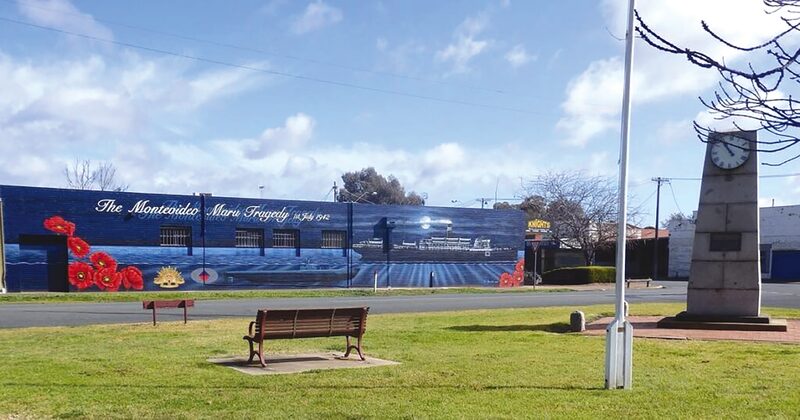
Painted by Benalla artist Tim Bowtell, the mural was initiated by the Stanhope RSL sub-branch, led by the driving force of its secretary, George Gemmill. Making it his business to know all 11 names listed on the township’s war memorial, George said:
“Stanhope RSL is very small. We only have eleven financial members and an average age of 75. But we are active, and when the idea of having a mural painted on the side of the local hardware store was raised, I immediately thought of the Montevideo Maru.”
When approached to paint the mural, artist Tim Bowtell admitted that, while he was embarrassed to have never heard of the Montevideo Maru, its story has left a proud and lasting impact on him.
“I had never heard of the Montevideo Maru when they contacted me. When I heard the story, I was actually shocked and a bit embarrassed that I didn’t know anything about it,” Tim said.
In an uncanny coincidence, the Stanhope mural was unveiled on April 15, 2023—just one week before the Montevideo Maru, was located at the bottom of the South China Sea.
Now an important annual event drawing many relatives of the fallen soldiers, the Stanhope RSL sub-branch has just held its third commemorative service for those lost on the Japanese transport ship beside the mural, on July 1.
Vital to honouring the legacy of each brave individual’s sacrifice during the tumult of war, the story of Stanhope’s Montevideo Maru is not only about remembrance, but also about the power of even the smallest communities to keep what might otherwise be a footnote in history alive, large, and meaningful. As Tim said,
“Stanhope RSL punches above its weight. Small groups like this, with drive and persistence, can make stories like this happen.”