
By Deanne Jeffers
THE Coalition has pledged to end open tender water buybacks if returned to power at the 2026 Federal election, a move welcomed by farmers and irrigation communities in the Goulburn Valley.
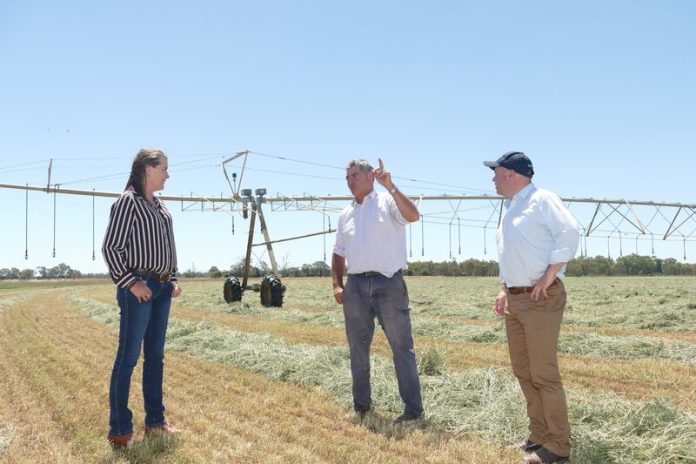
Shadow Water Minister Senator Perin Davey and Federal Member for Nicholls Sam Birrell unveiled their proposed water policy last week, which prioritises infrastructure upgrades, reinstating a socio-economic neutrality test, and halting open tender buybacks to protect regional economies.
“When people say buybacks are okay because farmers get compensated, what they’re not considering is the cost to the farmers who aren’t participating in the buybacks,” said Senator Davey.
“The flow on impacts of reduced production is very significant, and in areas like this where we’ve got dairy processing plants, if dairy production falls too much, some of those plants will close, then those factory workers that lose their jobs. Then they move, they take their families, and they move to where there is another job.”

Birrell criticised buybacks for driving up temporary water costs, straining farmers financially. “We’re fearful, and we want to stop buybacks if we form government next year,” he said.
Harston dairy farmer, Hamish Crawford, described the lasting impact of previous buybacks. “The temporary market is pretty good at the moment, but in the past, it’s been very scary, to around $500-$600 a megalitre, and that’s what I fear we will go back to one day. Less water in the consumptive pool means there is less water for us to buy,” he said.
“We used to do three billion litres [of milk] up here, and now we’re down to 1.8 billion [litres] in our Murray region. So, that makes me sad. It makes me sad that there’s not as much employment around and small towns aren’t as vibrant as they once were.”
“I wouldn’t blame it entirely on the Murray Darling Basin Plan by any stretch, but around here, I do mostly blame the Murray Darling Basin Plan.”
Crawford endorsed the Coalition’s proposal, saying, “It’s a heck of a lot better than the alternative.”
“The alternative is more buybacks, and as I’ve said previously, I’m against that, in fact, it’s already gone too far.”