
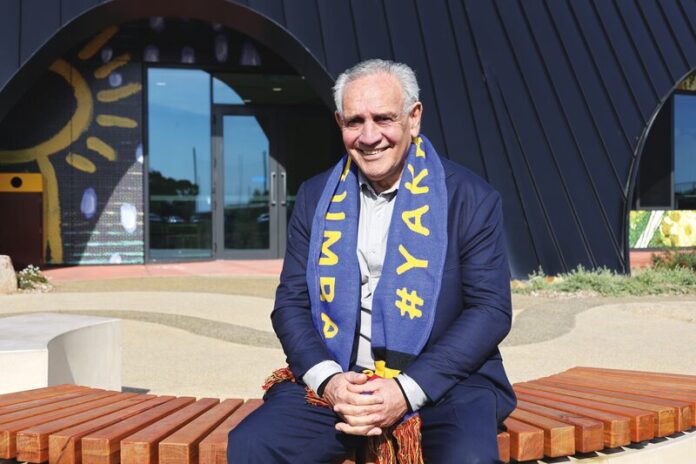
Message from Paul Briggs AO, Munarra Limited deputy chair
I’D like to thank everyone for joining us to celebrate such an important investment into our future and our shared future, and into our children’s future. The health and wellbeing of the next generation is a legacy that we want to be able to improve on. The strengthening of not just a vision for the future, but in building the strategy and skills to achieve it.
The Munarra Centre and Rumbalara Football Netball Club (RFNC) are powerful tools of change. Together with our allied partnerships and organisations that surround us, we are working to extract ourselves out of that crisis mode of operations. Having a vision is critical to be able to pull us out of the crisis elements of our community.
Some of the strengths that we’ve been able to achieve underpin the partnerships that will transform this region and act as a beacon of change to the rest of the nation. RFNC has really been a powerful tool for creating partnerships like the one with Melbourne University and the State Government.
I want to acknowledge the Elders present to witness the opening of the Munarra Centre. In particular people I’ve grown up with. Uncle Boydie – we talked about football and the invincible spirit of the Cummaragunja Football and Cricket teams and the championships that come off there. My dad, Les Briggs, who was born in 1896. He talked about those champion teams and champion runners, gift winners and footballers. The invincible spirit was well and truly alive. Uncle Boydie is almost 96 and a surviving member of the 1946 All Blacks premiership team, who played out of Dasher’s paddock between here and Mooroopna.
We were operating off the fringes, off the riverbanks, and off the tip sites at that point in time. We were in labouring roles, and we had a football team that lasted maybe one year and couldn’t continue for all sorts of reasons. So, Rumbalara has emerged from our Cummeragunja days in our journey to Dasher’s paddock after the 1939 walk-off at Cummeragunja. Now we’re present in front of this magnificent piece of infrastructure that’s connected to the heart and soul of the young people, and I’m just so proud of it.
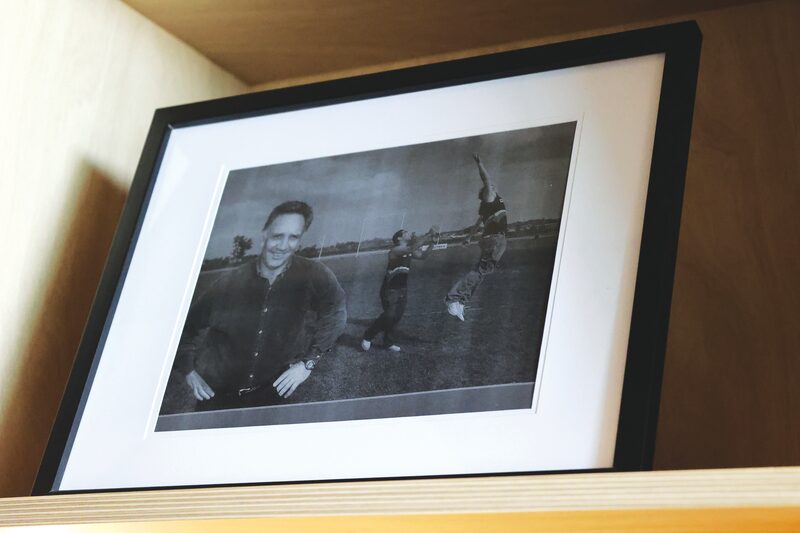
I’m proud of the achievements and the legacy that people like Uncle Boydie and others have established. The cultural integrity and family values that I’ve known as part of Yorta Yorta peoples that I’ve grown up with. I’m blessed to be part of that and hopefully that’s a legacy that we’re leaving for future generations.
At the official opening, we deliberately walked from the footy ground to Munarra. I’m mindful of where the footy club came from and our challenge over 15 years to be part of football and to be admitted into the AFL Victoria Affiliation. It’s a journey of trust and courage that the state took with us, in helping us put grass on the oval, putting the lights up, changerooms, and investing in something that was not accepted at that time, but that has now proven to be one of the great investments in our future.
So that walk across the big blue bridge into the Munarra Centre is a walk towards our future. It was a walk towards our access into mainstream tertiary education but also for ourselves to put investment back into research and inclusion of First Nations knowledge into curriculum, and to invest into the professional workforce development, not only for the other industries across this region, but into teaching the workforce to be able to meet the needs of our children in the educational learning centres.
We’re going to be able to work as an aggregator of education services and be a facilitator of professional development within the educational sphere. It’s also talking about cultural knowledge and reclamation of our language, of our cultural expression and how we bring ceremony back from a cultural perspective. That’s working with bodies like Yorta Yorta Nation, Rumbalara Co-Operative, Njernda Co-Operative and Kaiela Arts, and looking to where we have deficits or the need to create further infrastructure or skillsets to enable us to drive the future towards what we’re looking for.

Our history is quite a turbulent history. The piece of land that the RFNC sits on was purchased in 1992. I remember standing on the channel bank and thinking that’s a good spot – kids can ride their bikes and mums can push their prams. We can be independent in how we access the club, we’re not reliant on people. That was the first point, spending $180,000 to buy the land that now occupies RFNC and then later negotiations with the state and the council on access to this piece of land to build the Munarra Centre so that it becomes one precinct. It is magnificent.
The Munarra Centre is also an enabler that we built into the Goulburn Murray Regional Prosperity Plan. We’ve never had a plan. We walked off Cummeragunja in 1939 and we didn’t have a plan as to what we were going to do, we were doing it day by day. This is the first plan to talk about how we build an economy, but also how we protect our cultural integrity. It promises life expectancy, and it promises equality of life and outcomes for our young people. It also talks to regional productivity of $150M. If us black fellas can live as long and share in the same quality of life as everybody else, it is a win-win model of engagement.
We’re building really good partnerships around that, but it’s early days of work to be done. To say that we’re very optimistic about the ability of this to transform the future – transform it for ourselves as First Nations peoples, transform the region to create a health vibrant region that is inclusive, and be a beacon for other regions right around Australia; because I know that people are struggling and suffering everywhere, not just here. So, we have a responsibility to our brothers and sisters in other parts.
There are plans in the future to increase the footprint and have student accommodation and childcare, and to develop a centre for sports excellence to work with the young people. To have the facilities that can attract people from around the globe. To attract elite sporting competitions here and for us to be able to impact the 2032 Olympic Games. Opening opportunities for people to get onto the track and field, or other competitions and the chance to go into Aboriginal businesses and all sorts of forums – that’s what the Munarra Centre will be able to generate: the enthusiasm, the aspiration and the optimism that we can achieve this.